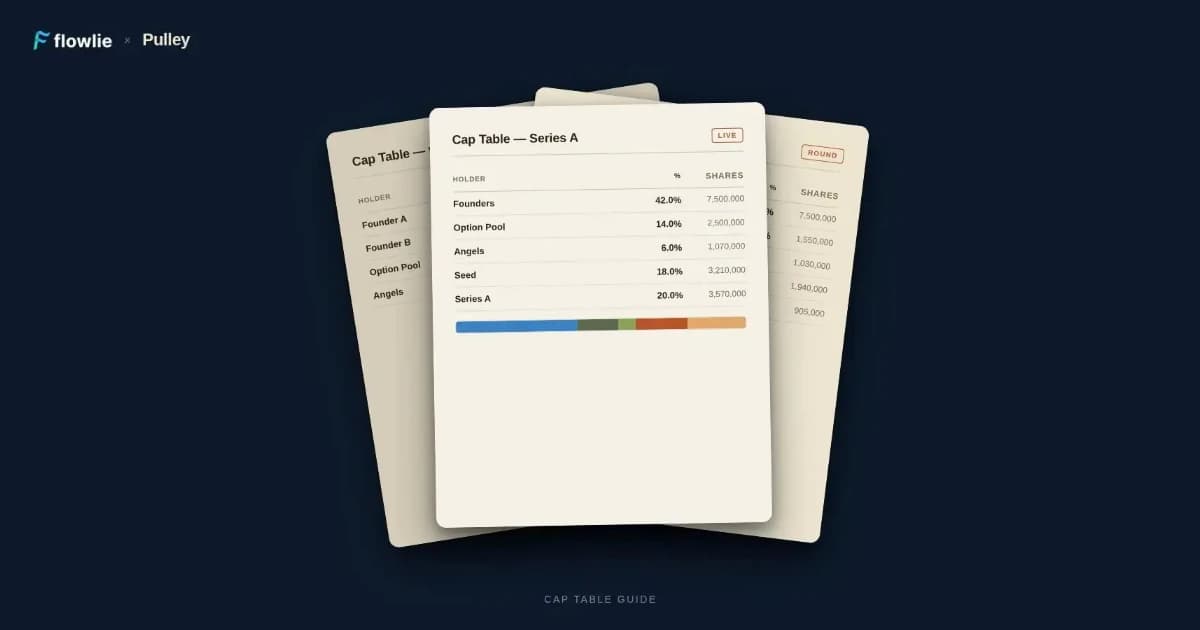
Why does dilution matter for venture backed founders?
Dilution matters because it directly determines what percentage of your company you'll own at exit, which translates to the actual dollars you receive when your startup is acquired or goes public, and because excessive dilution early in your company's life can leave you with minimal ownership by the time you achieve success. Every time you issue new shares during fundraising rounds or grant stock options, your ownership percentage decreases even though your absolute share count stays the same, and the cumulative effect across multiple rounds can be dramatic—founders who start with 100% ownership commonly end up with 10-20% by Series B or C. Understanding and managing dilution proactively enables you to make strategic decisions about how much to raise, at what valuation, and when, rather than discovering after signing term sheets that you've given away more equity than you're comfortable with for the capital received.
Beyond personal economics, dilution affects your control and influence over company decisions, your motivation to continue building through challenging years, and your ability to negotiate favorable terms in future rounds when investors evaluate whether founders remain sufficiently incentivized. A dilution calculator becomes your strategic ally in navigating these dynamics, allowing you to model different funding scenarios before committing to deals and answer critical "what if" questions about how various raise amounts, valuations, and investor requirements will impact your long-term stake. By simulating potential futures, you can negotiate from a position of knowledge, strategically plan your funding roadmap, communicate transparently with your team about equity implications, and maintain clear visibility into your future ownership rather than being surprised by how multiple rounds compound to reduce your stake far more than you anticipated.
The power of understanding dilution isn't about avoiding it entirely—dilution is essential for raising the growth capital that increases your company's value—but about ensuring that each dilution event is justified by the value created and that you retain sufficient ownership to make the eventual outcome meaningful. Owning 15% of a $500M company produces far better outcomes than owning 40% of a $20M company, so the goal is optimizing for absolute dollars rather than just percentage ownership. However, without modeling dilution proactively, founders risk raising too much capital they don't need, accepting too-low valuations that create excessive dilution, or agreeing to investor terms like large option pools that unnecessarily reduce their stake, all of which compound across multiple rounds to leave them with surprisingly small ownership of the companies they built.
This is where a dilution calculator becomes your strategic ally. It's not just about plugging in numbers after a deal is done; it's a powerful tool for proactive planning. By simulating different funding scenarios, you can gain invaluable insights into how future rounds might affect your ownership and make more informed decisions today.
Why Bother Forecasting Dilution?
Imagine you're about to enter your Series A round. You have a target raise in mind, and you've had preliminary valuation discussions. Instead of waiting to see the dilution impact after the paperwork is signed, a dilution calculator allows you to answer critical "what if" questions:
What happens to my co-founder's and my equity if we raise $X at a $Y valuation?
How will the introduction of an investor option pool impact our ownership?
If we need a follow-on Series B in 18 months, how might that further dilute our stake based on different potential valuations?
At what point might our individual ownership percentages fall below a certain threshold, and how can we plan for that?
By playing out these scenarios, you can:
Negotiate from a position of knowledge: Understanding the potential dilution allows you to better assess term sheets and negotiate for terms that align with your long-term vision.
Strategically plan your funding roadmap: You can anticipate the number of funding rounds you might need and the potential equity implications at each stage.
Communicate effectively with your team: Being transparent about potential dilution, especially regarding employee stock options, fosters trust and understanding.
Maintain a clear picture of your future ownership: This helps you stay motivated and aligned with your co-founders on the long journey ahead.
Putting a Dilution Calculator to Work (Even Before You Need It)
Think of a dilution calculator as a financial modeling tool specifically for your cap table. Here's how you can start using it proactively:
Input your current cap table: Start with your existing shares, founder equity splits, and any outstanding options or SAFEs.
Model your target raise: Enter the anticipated amount you plan to raise in your next round.
Experiment with different valuations: Play with pre-money and post-money valuation scenarios to see how they impact dilution. A higher valuation generally leads to less dilution for the same amount of capital raised.
Factor in investor option pools: Understand that investors often require a post-money option pool to attract and retain talent. Model the impact of this pool on your ownership.
Project future rounds: If you have a rough idea of your future funding needs, try modeling subsequent rounds to see the cumulative effect of dilution.
Frequently Asked Questions
At what point in my fundraising process should I use a dilution calculator?
Use a dilution calculator during fundraising preparation, ideally 2-3 months before approaching investors, to model different scenarios and understand your constraints before negotiations begin. Run additional models when you receive term sheets to compare actual offers against your projected scenarios, helping you evaluate whether proposed valuations and terms align with your ownership goals. Continue using the calculator throughout negotiations as terms evolve, and after closing to plan for future rounds based on your updated cap table. The biggest mistake founders make is waiting until after receiving a term sheet to model dilution, discovering too late that the deal creates more dilution than they're comfortable with. Early modeling lets you set realistic valuation expectations and walk away from deals that don't meet your minimum requirements.
What information do I need to use a dilution calculator effectively?
To use a dilution calculator effectively, you need your current cap table showing all shareholders and their share counts, any outstanding SAFEs or convertible notes with their terms, existing option pool size and allocation, the amount you plan to raise in your next round, estimated pre-money or post-money valuation range for that round, expected option pool increase that investors might require, and ideally projections for future rounds including timing, amounts, and potential valuation ranges. The more accurate your inputs, the more valuable your modeling becomes. If you don't have firm numbers for future rounds, use ranges and industry benchmarks to create multiple scenarios showing best-case, base-case, and worst-case dilution outcomes. Having this information organized before modeling saves significant time and enables quick scenario comparison.
How much dilution is typical for each fundraising round?
Typical dilution varies by round and company circumstances, but general ranges are 10-20% for seed rounds, 15-25% for Series A, 15-20% for Series B, and 10-15% for later rounds as valuations increase relative to capital needs. These ranges include both new investor shares and any option pool increases required by investors. Companies raising at strong valuations relative to traction dilute less, while those raising from weaker positions dilute more. Pre-revenue companies typically face higher dilution than those with proven business models. If your modeled dilution significantly exceeds these ranges, you may be raising at too low a valuation or raising more capital than necessary. Conversely, if you're diluting far less, you might have unusual leverage or be leaving money on the table by raising too little.
Can I negotiate dilution amounts with investors?
You can't directly negotiate dilution percentages, but you negotiate the factors that determine dilution: valuation, raise amount, and option pool requirements. Higher valuations create less dilution for the same capital raised, so valuation negotiation directly affects your dilution. Raising less capital reduces dilution but may leave you underfunded, while raising more increases dilution but extends runway. Investors often require expanding your option pool to specific post-money percentages like 15-20%, creating additional dilution; negotiate the pool size by demonstrating your hiring needs justify a smaller allocation. Use your dilution calculator to model different combinations of these factors, identifying which variables matter most for your ownership goals and where to focus negotiation energy for maximum impact on your final ownership percentage.
How do option pools affect founder dilution differently from new investor shares?
Option pools affect founder dilution differently depending on whether they're calculated pre-money or post-money. Pre-money option pools dilute existing shareholders including founders before new investors join, while post-money pools dilute everyone including new investors proportionally. Most modern deals use post-money option pools, meaning the required pool size dilutes founders and investors equally. However, if investors require a larger pool than you actually need for hiring, you're effectively giving away equity unnecessarily. Model the difference between the option pool size investors request and what you realistically need for your hiring plan; negotiate for the lower number using detailed hiring projections. Unused option pool shares remain authorized but unissued, diluting your percentage ownership on a fully diluted basis even though they're not in anyone's hands yet.
What's the difference between pre-money and post-money valuation in dilution calculations?
Pre-money valuation is your company's value before new investment, while post-money valuation is value after new investment (pre-money plus investment amount). The distinction critically affects dilution calculations. With a $10M pre-money valuation raising $2M, your post-money valuation is $12M and investors receive 16.67% ownership ($2M ÷ $12M). With a $10M post-money valuation raising $2M, your pre-money valuation is $8M and investors receive 20% ownership ($2M ÷ $10M), creating more founder dilution. Always clarify whether valuations discussed are pre-money or post-money to avoid miscommunication that dramatically affects your ownership. Post-money SAFEs have become increasingly common and are generally more founder-friendly because they cap the dilution at a clear percentage regardless of option pool size, unlike pre-money structures where option pools create additional unexpected dilution.
How do I model future rounds when I don't know exact terms?
Model future rounds using ranges and industry benchmarks when you don't have exact terms, creating multiple scenarios. For Series A timing, assume 12-18 months after seed close with typical runway requirements. For valuation, research comparable companies' Series A valuations relative to traction metrics like ARR or user growth, then apply those multiples to your projected metrics. Use standard dilution ranges (15-25% for Series A) to estimate new investor ownership. Model option pool increases assuming investors require 15-20% post-money pools. Create best-case scenarios with strong valuations and modest dilution, base-case scenarios with market-average terms, and worst-case scenarios with lower valuations and higher dilution. This range approach shows you whether you can tolerate worst-case dilution while pursuing best-case outcomes, or whether even base-case scenarios create unacceptable ownership impacts requiring strategy adjustments.
What ownership percentage should founders aim to maintain through Series A?
Most founders aim to maintain 40-60% combined ownership through Series A, with individual founder stakes typically around 15-30% depending on co-founder count and early investor presence. Maintaining 20%+ individual ownership through Series A is often considered strong, providing meaningful economic outcome and control. Falling below 10-15% individual ownership by Series A might signal excessive early dilution that could affect motivation and future fundraising leverage. However, these are guidelines not rules; founders of successful companies with 5% ownership at exit can still generate life-changing outcomes if the company reaches sufficient scale. Focus on absolute outcome rather than just percentage ownership—would you rather own 40% of a $10M company or 10% of a $500M company? Use dilution modeling to project what percentage ownership translates to meaningful dollars given your realistic exit scenarios.
How do SAFEs and convertible notes affect dilution modeling?
SAFEs and convertible notes create uncertain future dilution because they don't specify exact share counts at issuance, instead converting to equity in future rounds based on terms like valuation caps, discounts, and interest rates. Model SAFE dilution by calculating conversion at your anticipated Series A valuation using their valuation cap and discount terms, determining how many shares they'll receive, then including those shares in your dilution calculations. Post-money SAFEs are easier to model because the conversion percentage is fixed regardless of option pool size. Pre-money SAFEs and convertible notes require more complex modeling because option pools and round terms affect final conversion. If you have multiple SAFEs with different caps, model each separately then combine results. The challenge with SAFE modeling is that you don't know your future round valuation; run multiple scenarios showing conversion at different valuations to understand your dilution range.
What tools or calculators are best for modeling dilution?
Specialized startup dilution calculators like Flowlie's tool, Carta's calculator, or Pulley's modeling features are purpose-built for startup equity and handle complexities like SAFEs, option pools, and multi-round scenarios better than generic spreadsheets. These platforms typically offer pre-built templates, automatic calculations reducing error risk, scenario comparison features, and integration with cap table management. For basic needs, you can build Excel or Google Sheets models calculating dilution, though this requires understanding the math and building formulas correctly. Avoid overly simple calculators that don't account for option pools, SAFEs, or other complexities as they'll give misleadingly optimistic results. The best tool is one you'll actually use consistently; even a simple spreadsheet model used regularly beats a sophisticated platform you access once. Start with accessible tools, then graduate to professional platforms as your cap table complexity increases.
How does dilution affect my control and voting rights?
Dilution affects control and voting rights differently depending on your share class and governance structure. For common stock, your voting power dilutes proportionally with your ownership percentage; if you own 50% and dilute to 40%, your voting power drops similarly. However, board seats, protective provisions, and founder-friendly governance structures can maintain effective control even with minority ownership. Founders with board control through multiple founder board seats or board-election rights maintain operational control despite dilution. Protective provisions requiring supermajority votes for major decisions give minority shareholders control over specific actions. Some founders negotiate supervoting stock or dual-class structures maintaining disproportionate voting power relative to economic ownership. Model not just economic dilution but governance dilution by tracking board composition changes and protective provisions added in each round, understanding that practical control depends on governance structure not just ownership percentage.
What happens if I raise more or less money than originally modeled?
Raising more money than modeled creates additional dilution beyond your projections, potentially reducing your ownership below comfortable thresholds if the valuation doesn't increase proportionally. Raising less money than modeled might preserve more ownership but could leave you underfunded, forcing you to raise again sooner than planned and creating cumulative dilution through multiple smaller rounds that might exceed one larger round's dilution. When your actual raise differs from modeling, immediately update your calculator with new terms to understand true impact. If raising significantly more, negotiate for higher valuation to offset additional dilution. If raising significantly less, adjust hiring plans and milestones to extend runway, avoiding premature bridge rounds. The flexibility to revise your raise amount based on dilution modeling is one of the calculator's key benefits—seeing that raising an extra $500K creates 5% additional dilution might lead you to reduce the raise if you can achieve milestones with less capital.
How do I explain dilution to employees receiving stock options?
Explain employee dilution by first covering that everyone with equity gets diluted proportionally when the company raises capital, that dilution is necessary for growth capital that increases company value making a smaller piece potentially more valuable, and that their options typically come from a pool sized to absorb predictable dilution through several rounds. Show concrete examples using the dilution calculator: "if you receive options for 0.5% of the company today and we raise our planned Series A, your percentage might dilute to 0.4%, but the company's value increases from $10M to $30M, so your equity value grows from $50K to $120K." Emphasize that professional investors who understand dilution thoroughly are choosing to invest, validating that the dilution is acceptable given growth prospects. Be transparent about future rounds' likely dilution, setting realistic expectations rather than letting employees discover later that their percentage has dropped. Provide access to basic modeling tools so employees can project their own outcomes.
Should I optimize for maintaining ownership or raising sufficient capital?
Optimize for raising sufficient capital to reach meaningful milestones over preserving ownership percentage, as underfunded companies often fail or face worse terms in desperate future raises that create more dilution than initially raising adequate capital. The goal is maximizing absolute dollar outcome, not ownership percentage; owning 15% of a $500M company beats owning 40% of a $20M company. However, avoid raising more than necessary just because investors are willing, as this creates unnecessary dilution. Use dilution modeling to find the balance: enough capital for 18-24 months runway to reach milestones justifying a strong next round, but not so much that you dilute excessively for capital that sits unused. If modeling shows that raising adequate capital dilutes you below 10% this early, consider whether your valuation is too low or your capital needs are too high, potentially indicating business model issues requiring addressing before raising.
How often should I update my dilution models?
Update dilution models quarterly during active fundraising to reflect evolving terms, valuations, and capital needs, ensuring your scenarios remain realistic as circumstances change. After closing rounds, update immediately with actual terms to reset your baseline for future modeling. Between fundraising events, review models semi-annually or when significant business changes occur affecting your capital needs, timeline, or likely future valuations. Treat your dilution model as a living document requiring regular maintenance rather than a one-time analysis, similar to how you maintain financial projections. Schedule regular reviews with co-founders to discuss model assumptions, ensuring aligned expectations about future dilution and its implications. The founders who navigate dilution best are those who continuously model and discuss it rather than treating it as an occasional exercise before fundraising events. This regular engagement builds intuition about equity dynamics, enabling faster decision-making when opportunities or challenges arise.
Conclusion
By taking the time to forecast dilution, you're not just crunching numbers; you're gaining a deeper understanding of your company's equity dynamics and empowering yourself to make strategic decisions that will shape your future success. Tools like Flowlie's dilution calculator are designed to simplify this process, providing you with clear insights to navigate the exciting, yet complex, world of startup funding.
Good luck!