
ResourcesStructruing
How to Set Up and Manage Your Cap Table Before Fundraising
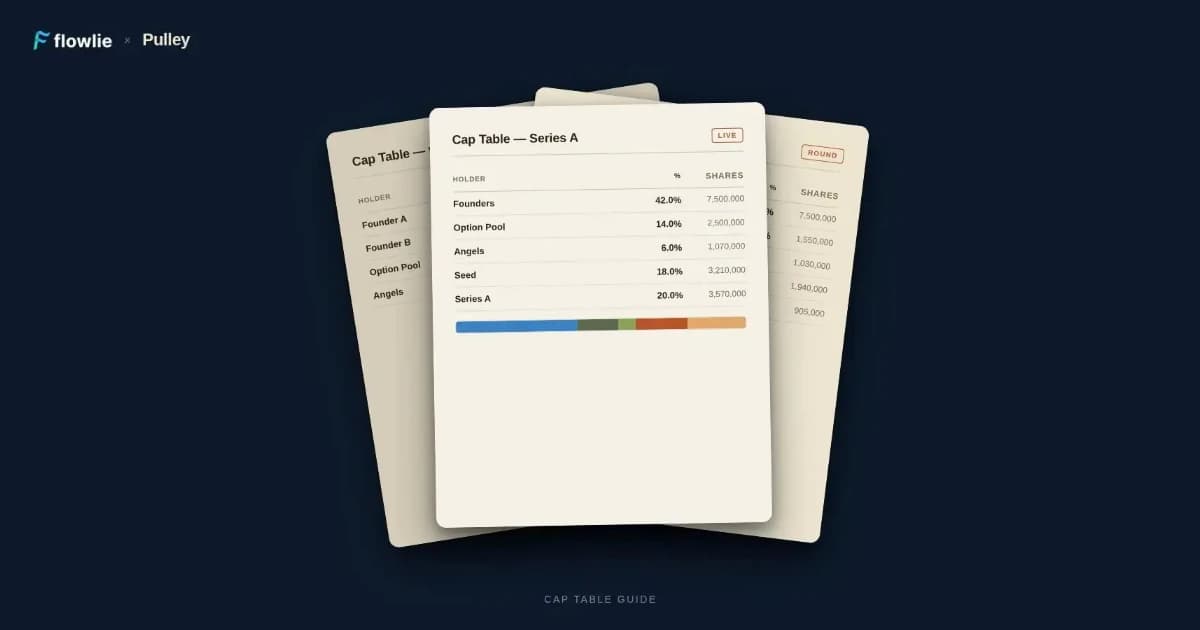
Keep your ownership structure clean, investor-ready, and properly modeled from day one - so your cap table never derails a deal.

Loading
Master your fundraising tool stack by understanding what Metal does well, where it falls short, and which alternatives actually fit your stage and budget.

Ariana Amirkhanian
Fundraising today isn’t just about who you know – it’s about how effectively you manage your network, track momentum, and convert conversations into capital. Tools like Metal have emerged to replace the messy spreadsheets founders once relied on, positioning themselves as AI-driven fundraising operating systems.
But the right alternative to Metal depends on what you actually need. If you want an end-to-end fundraising operating system with AI-powered investor discovery, warm intro mapping, and meeting intelligence, Flowlie is the closest match at a lower price point. If you mainly need a CRM with a bolted-on database, Foundersuite works. If investor relations and reporting matter more than discovery, Visible is your pick. Crunchbase is unbeatable for raw research data, and OpenVC offers a free, community-driven directory for founders on tight budgets.
Metal has built a solid product. Backed by Y Combinator and a16z, it offers investor discovery, network intelligence, pipeline management, and call analysis. But at $600/quarter ($200/month) on quarterly billing – or $450/quarter ($150/month) on annual – it's a real line item for a pre-seed or seed-stage founder watching every dollar of runway.
The bottom line: your fundraising tool should help you close your round – not chip away at the capital you’re trying to raise. Below, we break down five alternatives that deliver the same core value, without the same price tag.
Metal positions itself as an AI-driven operating system for fundraising. Its core pitch: use data to identify investors most likely to back your startup, then map your network to find the warmest intro paths.
What Metal does well:
The challenge is accessibility. Metal's pricing structure assumes you're far enough along to justify $150-200/month on tooling alone. For founders at pre-seed or early seed – the stages where warm intros matter most – that's a tough sell when you're also paying for hosting, legal, and everything else.
If you're looking for a platform that covers the full fundraising workflow – from building your target list to recording and analyzing your investor meetings – Flowlie is the most direct Metal alternative.
Built by former VCs, Flowlie is designed for Seed to Series B founders who need to run a tight, efficient process. Like Metal, it puts warm introductions at the center. Unlike Metal, it packages that alongside round planning tools, document sharing, and a more accessible price point.
What makes it a strong alternative:
Pricing:Starter plan at $49/month. Pro at $99/month with CRM, meeting analysis, and team collaboration. Premium at $499/month for hands-on support and strategy calls.
For most early-stage founders, the Starter or Pro plan covers everything you need at a fraction of Metal's cost.
Get started with Flowlie for free here.
Foundersuite has been around for years, and for good reason. It's a reliable CRM with a large investor database (230,000+ VCs, angels, family offices, and PE firms) that's helped over 87,000 startups manage their fundraising process.
The trade-off: Foundersuite is primarily a CRM and database. It doesn't offer the AI-driven fit scoring or network intelligence you get from Metal or Flowlie. If you're comfortable doing the manual research yourself and just need a structured pipeline to track conversations, it's a solid choice.
Key features:
Pricing: Free basic plan available. Paid plans start at $69/month, with annual billing options that reduce the cost. Check their website for current pricing tiers.
Visible (Visible.vc) is best known for what happens after you raise – keeping investors informed and engaged. They've since expanded into fundraising with pipeline tools and a database, but investor relations remains their sweet spot.
If you're a later-stage founder where reporting to existing investors is as important as finding new ones, Visible connects those two worlds well.
Key features:
Pricing: Fundraising-focused "Starter" plan at $69/month (billed monthly) or $59/month (billed annually). "Growth" plans at $249/month (billed monthly) or $199/month (billed annually).
Crunchbase isn't a fundraising operating system – it's a data library. It has the most comprehensive dataset on funding rounds, firm portfolios, and market trends in the industry. You use Crunchbase to research who led your competitor's Series A, not to manage your day-to-day fundraising workflow.
That said, it's an incredibly useful research tool that complements workflow-focused platforms. Many founders use Crunchbase for initial research and then manage execution in a dedicated fundraising tool.
Key features:
Pricing: "Pro" plan at $49/user/month (billed annually) or $99/user/month (billed monthly). "Business" plan at $199/user/month (billed annually).
OpenVC takes a different approach entirely. It's an open directory where investors opt in to receive pitches. No AI matching, no network mapping – just a transparent, community-driven database where you can filter by stage, check size, thesis, and geography.
For early-stage founders on a tight budget who want to supplement their warm intro strategy with targeted cold outreach, it's a useful free resource.
Key features:
Pricing: Core directory is free. "Premium" membership at $99/month (or $299/year billed annually) unlocks intro finder and increased outreach limits.
The "best" tool depends on where you are and what you actually need.
The universal advice: don't pay for features you won't use, and don't cheap out on tools that save you time during the most capital-intensive phase of your startup's life. Every week spent manually researching investors or managing a spreadsheet is a week you're not building product or talking to customers.
Metal is a strong product, but at $150-200/month it's a significant expense for pre-seed and seed-stage startups. If you're raising a large seed or Series A and investor intelligence is your primary bottleneck, the investment can pay for itself.
Yes, and many founders do. A common stack is platform like Flowlie for the active fundraise (discovery, pipeline, intros, analysis), and Visible for post-raise investor reporting. The key is avoiding redundancy – don't pay for three different investor databases.
You can technically run a fundraise from a spreadsheet or HubSpot. Many founders have. But general-purpose CRMs don't have investor databases, fit scoring, warm intro mapping, or fundraising-specific pipeline stages. A purpose-built tool saves meaningful time during a process where timing and momentum matter enormously.
Warm intro identification. Cold outreach to investors has notoriously low conversion rates. Any tool that helps you find and leverage warm paths to the right investors will deliver the highest return on investment. After that, pipeline management and investor fit scoring are the next priorities.
Fundraising CRMs are built around the investor pipeline – stages like "Researching," "Intro Requested," "Meeting Scheduled," "Term Sheet," and "Closed." They integrate investor databases, track deck engagement, and offer features like meeting analysis and warm intro mapping that general CRMs don't support without heavy customization.
Every tool on this list solves a real problem. Metal delivers strong investor intelligence. Crunchbase is unmatched for raw research. Foundersuite is battle-tested for pipeline management. Visible owns the post-raise reporting space. OpenVC is hard to beat at free. And Flowlie covers the most ground for founders who want discovery, intros, and pipeline in one place.
The right choice depends on your stage, your budget, and what's actually slowing you down. Don't pay for features you won't use, and don't cheap out on tools that save you weeks during the most time-intensive phase of building your company. Pick what fits, and get back to building.
Join thousands of founders using our technology to find the right investors and close rounds faster than ever before.
Keep your ownership structure clean, investor-ready, and properly modeled from day one - so your cap table never derails a deal.

Master post-raise spend management so your capital lasts long enough to hit the milestones that unlock your next round.
Learn why revenue alone isn't enough for investors, and how the TrueSpace + Flowlie partnership bridges the gap between being 'revenue-ready' and 'investor-ready' for second-stage companies.