How to Control Burn Rate After Closing a Funding Round
Master post-raise spend management so your capital lasts long enough to hit the milestones that unlock your next round.

Mark Bugas
April 21, 2026 · 12 min read

How to Control Burn Rate After Closing a Funding Round
What does controlling burn rate after a funding round actually mean?
Closing a round feels like the finish line. It isn't. The wire hitting your account is the moment your clock starts, and how you manage that capital over the next 18 to 24 months determines whether you raise again or run out of runway before you get there.
Burn rate control after a funding round means setting a spend budget tied directly to your milestone targets, putting systems in place to enforce it across your team, and monitoring it consistently enough to catch problems before they become existential. It's not about being cheap. It's about making sure every dollar you spend is moving you toward the metrics that justify your next raise.
Most founders know this in theory. Very few operationalize it the week after closing. This guide covers what to actually do.
What is burn rate and how do you calculate it?
Burn rate is how much cash your company spends each month, net of revenue. There are two numbers you need to track.
Gross burn is your total monthly expenses: salaries, software, office, contractors, cloud costs, everything. This tells you your absolute cost base.
Net burn is gross burn minus revenue. If you're spending $120K/month and bringing in $30K in revenue, your net burn is $90K/month. Net burn is the number that determines your runway.
Runway = cash in bank divided by monthly net burn. If you closed a $3M seed round and your net burn is $100K/month, you have 30 months of runway, assuming no revenue growth.
Net burn is what you report to investors and use for runway planning. Gross burn is what you track internally to understand your cost structure and where your money is actually going.
What's a normal burn rate at your stage?
Burn rates vary significantly by stage and industry. According to aggregated 2025 data compiled by ICanPitch from sources including Carta, OpenView Partners, and PitchBook:
Pre-seed: Median $25K/month
Seed: Median $85K/month
Series A: Median $350K/month
These are medians across all industries. A seed-stage B2B SaaS company and a seed-stage hardware company will look very different. ICanPitch's 2025 benchmarks break this down by sector if you want a closer comparison for your specific vertical.
What matters more than hitting a benchmark is whether your burn rate gives you enough runway to reach the milestones that unlock your next round, and whether you can defend your spend breakdown to an investor.
How to set a burn budget that maps to your milestones
Your burn budget shouldn't start with "what can we afford?" It should start with "what do we need to prove, and what does it cost to prove it?"
Work backwards from your next fundraise. If you're a B2B SaaS company that just closed a seed round, your Series A target is typically $2M to $6M ARR, with $2.5M as the current median per SVB's State of the Markets H1 2025 report. The range varies by sector and growth rate, and the bar has been moving up: SaaSstock's 2025 VC funding analysis found investors now expect Series A companies to be at $2M to $6M ARR, compared to sub-$1M just a few years ago. Map out the hires, tools, and growth spend required to get there. Total it up. Divide by your target runway. That's your burn budget.
Add a 25% buffer. Your assumptions will be wrong. Hiring takes longer than expected. A channel that looked promising won't convert. Revenue ramps slower. The buffer isn't pessimism: it's how you avoid raising your next round from a position of weakness.
Use Flowlie's Runway and Funding Calculator to stress-test this. Plug in your raise amount, your projected monthly burn, and your target ARR milestone, and you can see exactly how much runway you have against the numbers you need to hit. It's free and takes about five minutes.
Three rules for building a burn budget that holds
1. Tie every major spend category to a milestone, not a feeling. "We should hire a head of marketing" isn't a reason. "We need a head of marketing to generate 200 MQLs per month, which is the pipeline volume our model shows converts to $100K MRR by Q3" is. If you can't draw a straight line from a spend to a specific output (leads, revenue, retention), it shouldn't be in the budget.
2. Separate fixed costs from variable costs. Fixed costs (salaries, office, committed SaaS contracts) are harder to cut in a crunch. Variable costs (paid acquisition, contractors, events) can be dialed back quickly. Keep your fixed cost base lean enough that you could survive three or four bad months without a restructuring conversation.
3. Build the model in months, not quarters. Quarterly thinking creates blind spots. A 12-month model broken down month-by-month lets you see exactly when you hit key hiring milestones, when revenue needs to start offsetting burn, and how much runway you actually have at any given point.
How to enforce spend controls across your team
A budget is only as good as your ability to enforce it. Most early-stage teams fail here, not because they're irresponsible, but because they don't have systems in place before spend starts.
The week you close your round is the right time to set up spend infrastructure. Waiting until you have 10 people and four different people expensing things on personal cards is too late.
Set up a corporate card with built-in spend controls
The single highest-leverage thing you can do post-close is give your team corporate cards with pre-set limits by category, and stop reimbursing personal cards.
Reimbursement-based expense management has two problems. First, you lose real-time visibility into spend. Second, it creates a compliance burden as your team grows. By the time you're reconciling at month-end, you've already spent the money.
Corporate cards with spend controls solve both. You set category limits in advance, issue cards to team members, and get real-time visibility into every transaction. Anything outside the limits requires approval before the purchase happens, not after.
This is where Ramp stands out. Ramp is a corporate card and finance automation platform built specifically for startups and growing teams. Here's what makes it practical for founders managing post-raise spend:
Preset spend controls by vendor, category, or team member. Set a $2K/month cap on SaaS tools or a $300 limit per employee on meals, and Ramp enforces it automatically at the point of purchase. No approval needed for in-policy spend, no surprises at month-end.
Real-time visibility across all transactions. Every swipe shows up immediately in your dashboard, categorized and mapped to your budget. You see where your money is going as it's being spent, not three weeks later.
Automated receipt capture. Employees submit receipts via SMS, Slack, or the mobile app. Ramp matches them automatically, pre-fills categories, and syncs directly to QuickBooks, Xero, NetSuite, or Sage Intacct. No manual data entry, no chasing receipts at close.
No personal guarantee. Ramp evaluates your company's financial health, not your personal credit. This matters at the seed stage when you don't have years of business credit history.
AI Policy Agent. Ramp's AI reviews every expense, auto-approves in-policy transactions, and only escalates the ones that need human judgment. Finance teams consistently cite the time saved on approvals as the biggest operational win, according to G2 reviews.
Over 50,000 businesses use Ramp today, and the platform has processed and powers over $100 billion in purchases annually.
Flowlie is a Ramp partner. Founders who sign up through this link get a $500 bonus when they hit $1K in spend within 90 days. If you're setting up your finance stack post-close, it's a straightforward way to start with the right infrastructure and get something back for it.
Assign a single owner for financial oversight
At the seed stage, this is usually the CEO or a co-founder. At Series A, you likely need a fractional CFO or a finance lead. Someone needs to own the P&L review cadence and be the person who says "that hire is off-budget" or "we need to pause this channel spend."
Without a named owner, budget decisions happen by default rather than by design.
Set a monthly review cadence
Review actuals vs. budget every month, not every quarter. Look at net burn vs. plan, gross burn by category, updated runway, and any spend that happened outside the approved budget. Thirty minutes with the right numbers in front of you is enough to stay on track.
The most common post-raise spending mistakes
Founders who've been through multiple rounds talk about the same patterns. These are the ones worth knowing before you make them.
Hiring too fast, too broadly. The instinct after closing is to build the team you always imagined. Resist it. Each hire adds permanently to your fixed cost base. Hire for the specific role that's currently the bottleneck, not the org chart you want to have in two years. Carta's State of Seed 2025 report found that the average seed-stage company now has 6.2 equity-holding employees, down from 10.3 at the 2021 peak. Lean teams are the norm, not the exception.
Over-building before validating. Spending heavily on infrastructure, tooling, or product features before you've validated that customers want them. Capital should accelerate a validated model, not subsidize exploration indefinitely.
Lifestyle creep in operating costs. Office upgrades, premium SaaS tools, team offsites: individually defensible, collectively dangerous. Set a policy where any new recurring expense above a certain threshold, say $500/month, requires explicit sign-off.
Not tracking net burn weekly. Monthly reviews catch problems after they've compounded. A simple weekly check (cash balance, net burn for the week, projection to end of month) takes 10 minutes and prevents surprises.
Confusing gross burn and net burn. Founders sometimes optimize gross burn while revenue is declining, which means their actual runway is shorter than they think. Track both, always.
When to revisit your burn rate
Your burn budget isn't a set-and-forget document. There are specific triggers that should prompt a full review.
- When you miss a revenue milestone. If you're behind on revenue, your net burn is higher than planned and your runway is shorter. Revisit the budget before it becomes a crisis.
- When a key hire doesn't work out. Backfilling a role adds cost and delays output. Recalibrate your milestone timeline and spend plan accordingly.
- When market conditions shift. A channel drying up, a competitor making a major move, or a pricing change that affects your CAC all have downstream effects on your burn model.
- When you have 9 to 12 months of runway remaining. This is when you need to either raise your next round or make meaningful cuts to extend runway. Don't wait until you're at 6 months: that's when you're raising from a position of weakness, and investors can tell.
The median time between a seed round and a Series A has stretched to 2.2 years, per Carta's 2025 data reported by SaaStr. The full-year 2025 picture is consistent: Carta's 2025 in Review report shows startups raised nearly $120 billion in 2025, but across fewer deals and at higher bars than ever, meaning the companies that didn't make the cut are sitting on longer runways waiting for the right moment. The standard 18-month runway target is no longer safe. Target 24 months minimum, and use Flowlie's Dilution Calculator to model what extended timelines mean for your cap table across future rounds.
FAQ
What's the difference between gross burn and net burn?
Gross burn is your total monthly expenses. Net burn is gross burn minus revenue. If you spend $100K and earn $30K, gross burn is $100K and net burn is $70K. Runway is always calculated on net burn.
How do I know if my burn rate is too high?
Benchmark against your stage and sector using resources like ICanPitch's 2025 burn rate benchmarks. But the more important test is: does your current burn rate give you enough runway to hit your next round's target metrics? If the answer is no, your burn is too high for your current trajectory.
When should I start fundraising again based on my runway?
Start raising with 9 to 12 months of runway remaining. Never let runway drop below 6 months during an active raise. With the median time between seed and Series A now at 2.2 years per Carta, earlier is always better.
What's a burn multiple and why do investors care about it?
Burn multiple is net burn divided by net new ARR. It tells you how much you're spending to generate each new dollar of recurring revenue. According to CFO Advisors' 2025 benchmarks, the median for Series A SaaS companies sits at 1.6x. Below 1.5x is considered strong. Above 2x raises flags unless your growth rate is exceptional.
Should I hire a CFO after closing a seed round?
Probably not full-time. A fractional CFO is usually sufficient at seed stage. They can set up your financial model, review monthly actuals, and prepare investor-ready financials without the full-time cost. Revisit the decision when you're approaching Series A.
How do I handle a team member who consistently overspends their budget?
Address it directly and early. Make spend limits visible to everyone on the team as a shared operating principle, not a punishment. Corporate card controls help here because they enforce limits at the point of purchase rather than requiring a conversation after the fact.
What's the right runway target after closing a seed round?
Target 24 to 30 months, not 18. Fundraising cycles have lengthened significantly. The median gap between seed and Series A is now 2.2 years per Carta, and that's the median: many founders are taking longer. More buffer means more shots on goal and more negotiating leverage when you go out to raise.
Do I need accounting software from day one post-close?
Yes. QuickBooks or Xero are standard at seed stage. Set them up before you start spending, not three months in when you're trying to reconcile a messy spreadsheet. If you're using Ramp, it syncs directly with both, which removes a significant chunk of the manual work involved in keeping clean books.
What's the $500 Ramp bonus Flowlie mentions?
Flowlie has a partnership with Ramp. If you sign up through Flowlie's partner link, you get a $500 bonus when you reach $1K in spend within your first 90 days. Most post-seed startups will hit $1K in spend in their first week. It's a straightforward bonus for setting up the tool you'd be using anyway.
Burn Rate Management After a Funding Round: Key Takeaways
Closing a round gives you capital. How you manage it determines what comes next.
The founders who make it to their Series A consistently do the same things: they build a burn budget that maps directly to milestones, they set up spend infrastructure before their team starts spending, they track actuals vs. plan every month, and they start their next raise with enough runway to negotiate from strength.
The ones who don't make it often know the right principles. They just don't operationalize them early enough. A budget that lives in a spreadsheet no one reviews isn't a budget. Expense policies that exist as Slack messages aren't policies. Burn rate control is a system, not an intention.
Set up that system the week you close. Use Flowlie's Runway and Funding Calculator to model your runway and stress-test your spend assumptions against your milestone targets. Get your corporate card infrastructure in place so you have real-time visibility from day one: Ramp's partner offer through Flowlie is a practical starting point, with a $500 bonus built in. Review actuals every month. And start building toward your next raise before the pressure is on.
Related articles

What is Flowlie? The Complete Guide to Flowlie's Back Office
Learn how Flowlie helps startup founders save hours and have a streamlined process.

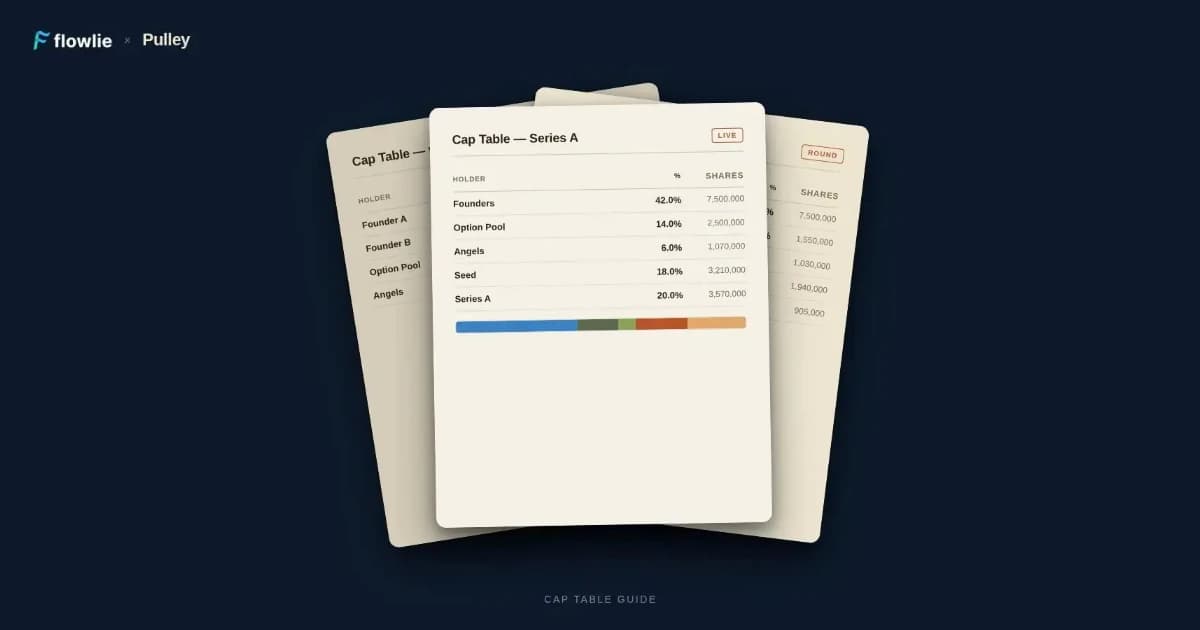
How to Set Up and Manage Your Cap Table Before Fundraising
Keep your ownership structure clean, investor-ready, and properly modeled from day one - so your cap table never derails a deal.
Fundraising Tools: 5 Alternatives to Metal
Master your fundraising tool stack by understanding what Metal does well, where it falls short, and which alternatives actually fit your stage and budget.