

ResourcesOperations
How to Control Burn Rate After Closing a Funding Round
Master post-raise spend management so your capital lasts long enough to hit the milestones that unlock your next round.

Loading
Keep your ownership structure clean, investor-ready, and properly modeled from day one - so your cap table never derails a deal.
Mark Bugas
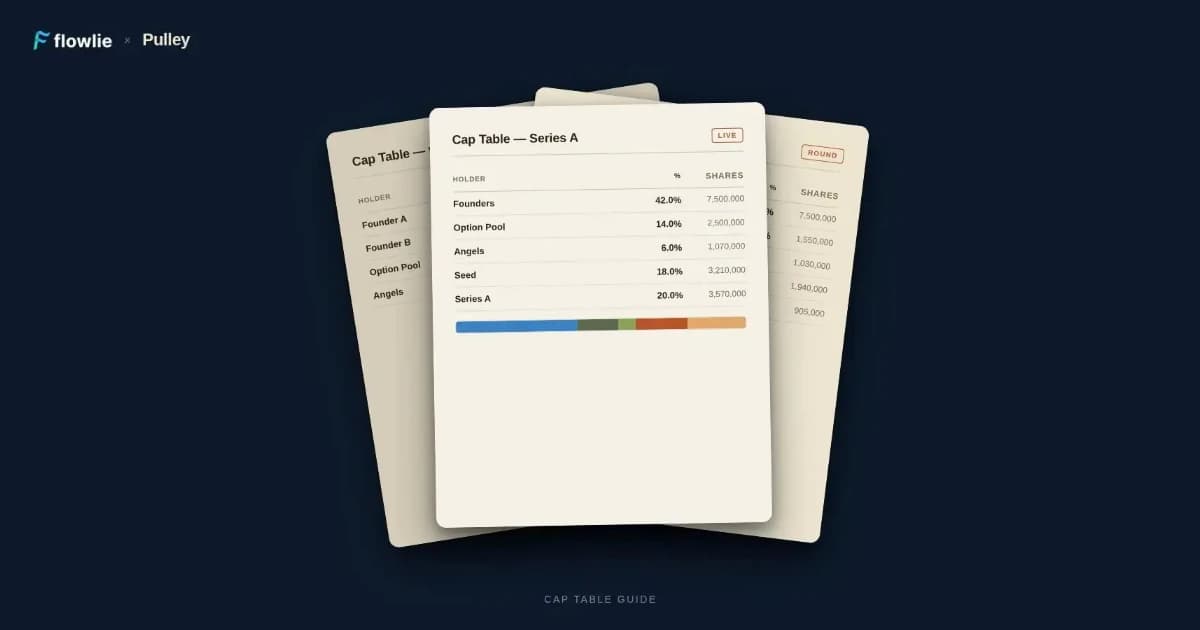
Your cap table is one of the first documents investors review during due diligence. It shows how control, ownership, and economic upside are distributed across founders, employees, and existing investors. If it's inaccurate, incomplete, or poorly structured, it raises questions about everything else in your company - not just your equity.
Getting it right isn't a one-time task. It's an ongoing discipline that directly affects your ability to raise, how quickly deals close, and how much leverage you have at the negotiating table.
Investors expect cap tables to meet three basic standards before they'll take a deal seriously.
First, accuracy - every equity grant, SAFE, convertible note, option, and warrant needs to be reflected in one authoritative record, backed by the legal documents that created them. Second, clarity - your ownership structure should be straightforward: common stock for founders and employees, one class of preferred for each round of investors, and a documented option pool. Third, it needs to be modeled on a fully diluted basis, showing not just what's been issued but what could convert or be exercised. If your cap table only reflects outstanding shares without accounting for options and convertible instruments, investors are looking at an incomplete picture.
The practical implication: founders who build these habits early move through due diligence faster and negotiate from a stronger position. Those who scramble to clean up their cap table mid-raise slow their own deals down.
Investors look at founder ownership percentage as a proxy for long-term commitment. If a founder's ownership is too low relative to investors at the seed stage, it raises a direct flag about incentive alignment - whether founders will stay motivated through the years of work ahead. Leslie Feinzaig of Graham & Walker put it directly: investors want founders to have a lot of skin in the game.
Industry norms are well documented. According to Carta's Founder Ownership Report, the median founding team collectively owns 56.2% after a seed round, dropping to 36.1% after Series A. Median dilution at Series A is around 20%. If you're giving away significantly more than 20% at seed, you're compressing what's left for future rounds - and potentially flagging over-dilution before you've even reached institutional investors.
A missing or exhausted employee option pool signals hiring and retention risk to investors. The standard is to reserve 10-20% for an employee stock option plan (ESOP) before or alongside early fundraising rounds. If you haven't set one up, or you've already burned through it without replenishing, investors will notice.
The mechanics matter too. Options need to be granted with the right documentation: a board resolution, an individual option agreement, and signed acceptance from the recipient. A cap table entry with no backing legal documents is essentially a promise on paper.
SAFEs and convertible notes are standard at pre-seed and seed stages, but they create ownership uncertainty if you don't model their dilutive impact before they convert. Recording SAFEs incorrectly, or failing to account for converted instruments, makes your cap table unreliable - and investors discovering errors during diligence start questioning what else you've gotten wrong.
Before you raise your next round, you need a clear picture of what your cap table looks like post-conversion across different valuation scenarios.
Most founders start with a spreadsheet. Most founders eventually regret it.
Cap table errors can kill fundraising deals. Missing documentation, misrepresented share classes, and unconsolidated investor lists are red flags that surface during due diligence and derail rounds that seemed certain. Spreadsheets don't update in real time, don't catch calculation errors automatically, and fall apart fast once you add multiple rounds, option pools, and convertible instruments to the mix.
The solution is purpose-built cap table software. Pulley is built specifically for founders and finance teams - not law firms or VCs - which means the interface is designed to help you stay accurate without needing a paralegal to operate it. It handles cap table management, option grants, 409A valuations, SAFE tracking, and fundraising scenario modeling in one place.
The fundraising modeling feature is particularly useful before a raise. You can model how different SAFE structures, valuation caps, and round sizes affect your ownership before you walk into an investor meeting - so you're not doing dilution math on the fly during term sheet negotiations.
Based on Cooley's standard VC diligence checklist, investors expect to find the following immediately accessible:
If any of these are missing or take more than 24 hours to produce, it slows your deal and signals operational sloppiness. Investors view cap table hygiene as a proxy for how you run the rest of your business.
Knowing how to structure your raise - and what it does to your cap table - is just as important as knowing what to put in your pitch deck.
Before you go out to investors, you need to model a few scenarios: what does your cap table look like if you raise at your target valuation vs. 20% below it? What happens to founder ownership if existing investors exercise their pro rata rights? What does conversion of your outstanding SAFEs do to available allocation for new investors?
Flowlie's Dilution Calculator is built for exactly this - you enter your current ownership split and model up to three rounds, seeing how each one changes founder stakes and stake values in real time. It answers the ownership question: how much of the company will each founder hold after this raise, and after the next one?
The separate Runway & Funding Calculator answers a different question: how much should you actually raise? Enter your burn rate, revenue, and growth assumptions, and it tells you how long your cash lasts, when you hit profitability, and what funding amount covers you with a safety buffer.
Combined with Pulley's fundraising modeling tools - which show exactly how SAFEs, convertible notes, and new equity rounds flow through your cap table - you have the full picture before you start investor conversations: how much to raise, how it affects ownership, and what your cap table looks like post-close.
These are the most common issues that create friction during due diligence:
What's the difference between basic shares outstanding and fully diluted shares? Basic shares outstanding counts only shares that have been issued and are currently held. Fully diluted shares include everything that could convert to equity: outstanding options, warrants, SAFEs, and convertible notes. Investors model on a fully diluted basis because that's what reflects the actual ownership picture after a round closes. If you only show basic shares, you're understating how much dilution is coming.
When should I set up an employee stock option pool? Before your first institutional raise, ideally when you incorporate. A standard ESOP reserves 10-20% of your fully diluted shares for employee equity. Investors often require you to establish or replenish the option pool as part of a new round - and they'll typically require that the pool be created pre-money, which increases the dilution founders absorb rather than spreading it across all shareholders.
Does it matter which cap table software I use? It matters less which tool you use and more that you use one consistently from the start. That said, Pulley is a strong choice for founders specifically - it's priced accessibly at the early stage, the interface doesn't require legal expertise to operate, and it covers the full range of what you need: cap table management, option grants, SAFE tracking, 409A valuations, and fundraising scenario modeling. Moving from a spreadsheet to dedicated software later is possible but requires careful data migration.
What is a 409A valuation and when do I need one? A 409A is an independent appraisal of your company's fair market value, required by the IRS before you can grant stock options to employees. If you issue options without a current 409A, you risk significant tax penalties for your employees. You need a new 409A whenever you complete a funding round, at least once every 12 months, or whenever there's a material change to your business. Pulley offers 409A valuations directly through the platform.
What's the right founder ownership threshold going into a Series A? Per Carta's Founder Ownership Report, the median founding team owns 56.2% after seed and 36.1% after Series A, with median Series A dilution running around 20%. If you're heading into a Series A with founders holding well below 50% combined, it can raise questions about over-dilution and long-term alignment. Use Flowlie's Dilution Calculator to model your ownership trajectory across multiple rounds before committing to terms.
How do I handle a former co-founder's equity? This depends on whether vesting was set up correctly at the start. If the departing co-founder had a standard 4-year vest with a 1-year cliff, unvested shares should have been returned to the company (typically to treasury or cancelled) when they left. If there's no vesting schedule, or if it wasn't enforced, you may have a dead equity problem that requires legal counsel to resolve. Document the departure and any equity repurchase in your cap table immediately.
Can investors see my cap table before they invest? Yes - and they should. A serious investor will request your cap table as part of due diligence. Providing it proactively, in a clean and current format, signals confidence and operational maturity. The version you share should be fully diluted and include all outstanding SAFEs, notes, options, and warrants. Use your data room for this rather than sending the file directly over email.
How often should I update my cap table? After every equity transaction - immediately. That means every option grant, SAFE issuance, convertible note, equity round, option exercise, and cancellation. Waiting until the next fundraise to reconcile is a recipe for errors that are expensive to fix. Dedicated software like Pulley makes this easier because the record updates with each transaction rather than requiring manual spreadsheet edits.
A clean cap table doesn't just make due diligence smoother - it signals to investors that you understand how your company works and that you've been running it with discipline.
The founders who close rounds efficiently are the ones who treated their cap table as a live, accurate record from day one rather than a document they clean up when investors ask for it. That means dedicated software, consistent updates after every equity transaction, proper documentation for every grant, and scenario modeling before you go out to raise.
Use Pulley to keep your cap table accurate and model the equity impact of your raise before you start investor conversations. Use Flowlie's Dilution Calculator to see how each round changes founder ownership across multiple scenarios, and the Runway & Funding Calculator to determine how much you actually need to raise and how long your runway lasts. The tools cover different parts of the same problem - cap table hygiene, ownership modeling, and funding planning - so you're not walking into investor meetings doing math on the fly.
Start your free trial of Flowlie and explore Pulley to get both sides of the equation in place before your next raise.
Join thousands of founders using our technology to find the right investors and close rounds faster than ever before.
Master post-raise spend management so your capital lasts long enough to hit the milestones that unlock your next round.
Master your fundraising tool stack by understanding what Metal does well, where it falls short, and which alternatives actually fit your stage and budget.

Learn why revenue alone isn't enough for investors, and how the TrueSpace + Flowlie partnership bridges the gap between being 'revenue-ready' and 'investor-ready' for second-stage companies.