What is Flowlie? The Complete Guide to Flowlie's Back Office
Learn how Flowlie helps startup founders save hours and have a streamlined process.

Ariana Amirkhanian
June 2, 2026 · 14 min read

TL;DR: Flowlie is the autonomous back office for venture-backed companies. One team running finance, HR, compliance, and fundraising as a single function. Companies bring Flowlie in after a round closes, when they need institutional infrastructure but are not ready to build a finance team in house. Pricing is one monthly retainer that scales with stage. Compensation is never tied to a fundraise or any deal outcome.
The Team Behind Flowlie
The Flowlie platform was built by a team of founders and former investors who experienced the fundraising process's inefficiencies firsthand.
- Vlad Cazacu (Co-founder & CEO): An ex-VC investor with experience at four different venture firms. He is a second-time founder, a 40x angel investor, and a published author on the venture ecosystem, providing deep insight into investor decision-making.
- Mark Bugas (Co-founder & COO): A repeat founder and experienced go-to-market and revenue leader. Mark has scaled B2B SaaS products from $0 to over $20M ARR as a sales leader and previously held investing roles at VC firms.
- Giovanni Ilacqua (Co-founder & CTO): A software engineer with extensive experience in AI architecture, mission-critical public safety systems, and network intelligence technologies.
What Flowlie is
Flowlie runs the back office for venture-backed companies from Seed to Series C. Finance, HR, compliance, and fundraising, delivered as one function by a dedicated team.
Most companies at this stage assemble the back office from parts. A bookkeeper, a fractional CFO, an HR consultant, a compliance specialist. Each vendor sees a slice of the company. Nobody owns the whole picture, and the founder becomes the glue. Flowlie replaces that stack with one function and one point of accountability.
Flowlie is not software you subscribe to, and it is not an advisory firm that sends memos. It is an operating team embedded in your company, doing the work.
What Flowlie does
- Finance. Books, monthly close, cash management, financial planning, and board reporting. Your numbers are accurate, current, and ready when a board member or lender asks a question.
- Human Resources. Payroll, benefits, onboarding and offboarding, and the people infrastructure that has to be right before you scale headcount.
- Compliance. Federal, state, and local filings, registrations, insurance, and risk. The category of work that is invisible when it is done and expensive when it is not.
- Fundraising. Preparation for your next equity or debt raise: the model, the materials, the diligence readiness, and the intelligence on which investors to talk to and when. Flowlie is not a banker or a broker. We never take a percentage of the raise, and we never communicate with investors on your behalf. The raise is yours.
Who Flowlie is for
- Venture-backed companies between Seed and Series C
- Companies that have just closed a round and need institutional infrastructure faster than they can hire it
- Founders deciding between a first finance hire and an outsourced stack, and finding that neither covers the full function
- Teams of roughly 10 to 100 people, headquartered in the US
Who Flowlie is not for
- Companies with a full-time CFO already in seat. Flowlie replaces the need to hire one, not the person you already have.
- Companies that only want bookkeeping. Basic books are an input to what we do, not the product.
- Founders looking for a broker or placement agent. We do not raise money for you.
Pricing
One monthly retainer covers the full function. No deal fees, no per-seat software, no four invoices to reconcile.
| Tier | Profile | Retainer |
|---|---|---|
| Seed | Raised Seed or $1M+ ARR | $7,500/month |
| Series A | Raised Series A or $3M+ ARR | $10,000/month |
| Series B | Raised Series B or $6M+ ARR | $15,000/month |
| Series C+ | Custom scope for later-stage complexity | Custom |
For context: a first full-time finance hire, such as a VP of Finance, runs $150K to $200K a year and covers one quarter of this scope.
FAQ
Is Flowlie a fractional CFO firm?
No. A fractional CFO gives you a person for a few hours a week. Flowlie gives you the full function: the strategic work a CFO does, plus the operational work a finance team, an HR lead, and a compliance specialist do, running continuously.
Does Flowlie replace my bookkeeper?
Yes. Books and close are part of the Finance pillar. If you currently use Pilot, Kruze, or a local firm, that work moves to Flowlie.
We already have a CFO. Is Flowlie a fit?
Usually not. Flowlie exists for the window before that hire makes sense. If you have a full-time CFO, you have someone who owns the function already.
Does Flowlie take a percentage of the raise?
No. Compensation is never tied to a fundraise or any deal outcome. Flowlie is not a registered broker-dealer and does not act as one.
Does Flowlie talk to investors for me?
No. We prepare the company, the model, and the materials. You run the conversations.
What stages does Flowlie support?
Seed through Series C. Most companies come to us right after closing a round.
What happens to my current vendors?
Flowlie replaces the service vendors: the bookkeeper, the fractional CFO, the HR consultant. The tools stay. We work with partners like Ramp and Rho and run them for you. Where a specialist should stay, such as your tax preparer or outside counsel, we coordinate with them directly so you do not have to.
Where to start
Tell us where you are and what you need. We'll tell you whether Flowlie is a fit, and if not, who is.
Related articles
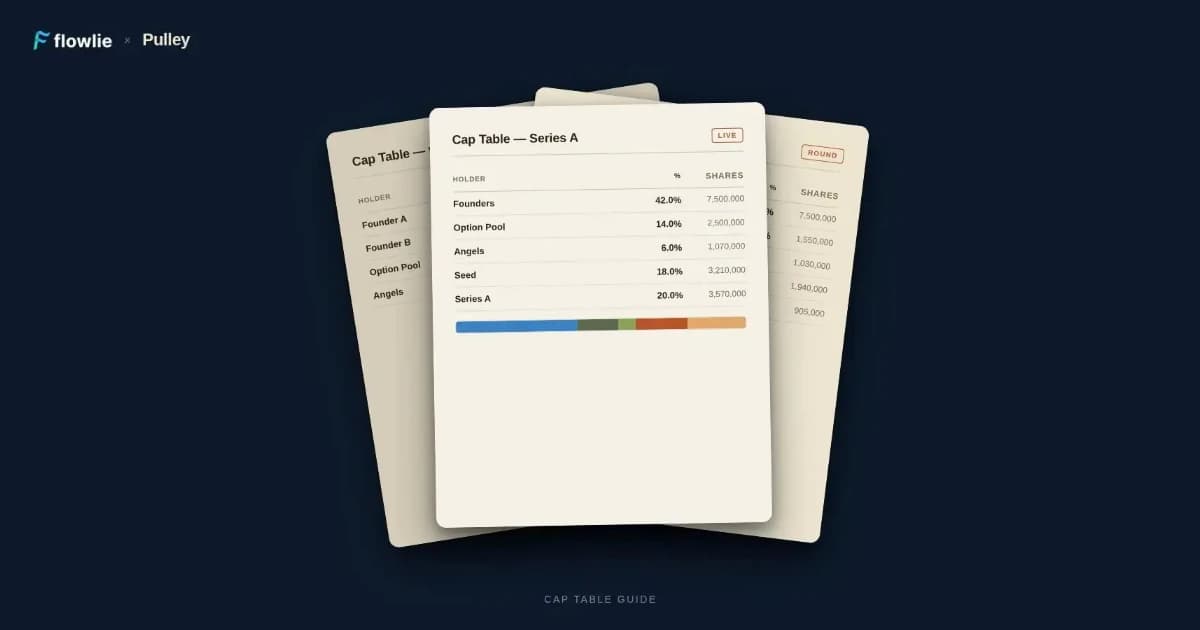
How to Set Up and Manage Your Cap Table Before Fundraising
Keep your ownership structure clean, investor-ready, and properly modeled from day one - so your cap table never derails a deal.


How to Control Burn Rate After Closing a Funding Round
Master post-raise spend management so your capital lasts long enough to hit the milestones that unlock your next round.
Fundraising Tools: 5 Alternatives to Metal
Master your fundraising tool stack by understanding what Metal does well, where it falls short, and which alternatives actually fit your stage and budget.